
What Is a Balanced Market in Vancouver Real Estate? (And What It Means for You)
Real estate markets move through distinct cycles, and understanding these conditions helps both buyers and sellers make confident, strategic decisions. One of the most stable market environments is known as a balanced market.
In Metro Vancouver, where fast-paced seller’s markets are common, a balanced market can often feel like a buyer’s market. However, it actually represents a neutral landscape where supply and demand are aligned, and neither buyers nor sellers hold a distinct advantage.
Let’s take a closer look at what a balanced market means, how it is measured in Vancouver, and how you can navigate it effectively.
What Is a Balanced Market?
A balanced market occurs when the number of properties available for sale roughly matches the number of buyers actively searching for homes. Properties sell at a steady pace, prices remain relatively stable, and homes usually close close to their listing prices.
The Math Behind it: Sales-to-Active Listings Ratio
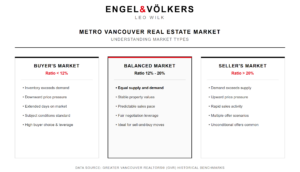
In Metro Vancouver, real estate analysts track market conditions using the Sales-to-Active Listings Ratio. According to historical data from Greater Vancouver REALTORS® (GVR):
-
Below 12%: Buyer’s Market (sustained pressure pushes prices down)
-
12% to 20%: Balanced Market (prices remain relatively stable)
-
Above 20%: Seller’s Market (sustained pressure pushes prices up)
Key Takeaway for Vancouver: Remember that market conditions can vary widely by property type and neighborhood. Detached homes in one suburb might be in a balanced or buyer’s market, while family townhomes or affordable condos in another area remain in a seller’s market.
Key Indicators of a Balanced Market
How do you know when Metro Vancouver is in a balanced state? Watch for these main indicators:
-
Moderate Inventory Levels: Enough active listings exist to give buyers meaningful options, but not so many that sellers struggle to get showings.
-
Reasonable Days on Market (DOM): Homes do not vanish within 48 hours, nor do they sit for months without activity.
-
Stable Property Values: Home prices appreciate gradually or plateau rather than spiking or dropping abruptly.
-
Fewer Multiple Offer Scenarios: While hot properties can still receive competing bids, standard bidding wars are rare. Buyers generally have time to include subjects (such as financing or home inspection) and negotiate fair terms.
What a Balanced Market Means for Sellers
A balanced market offers favorable, predictable conditions for sellers—especially those planning to sell and buy in the same market.
-
Fair Market Value Sales: Realistically priced properties sell near their list price without relying on aggressive bidding wars.
-
Pricing Strategy Is Crucial: Because buyers have competing options, overpricing your property will cause it to sit on the market. Accurate pricing based on recent comparable sales is essential.
-
Property Presentation Matters: Staging, professional media, and thorough preparation help your property stand out from competing inventory.
What a Balanced Market Means for Buyers
For buyers, a balanced market provides relief from high-pressure market dynamics.
-
More Time to Decide: You can evaluate options, attend second showings, and perform due diligence without fear of losing a home overnight.
-
Subject Conditions Are Back: Buyers can protect themselves by including essential subject conditions, such as financing approvals, home inspections, and strata document reviews.
-
Negotiation Power: Sellers are generally more open to negotiating on price, repairs, or target closing dates.
How to Navigate a Balanced Market
Strategy still drives success in a neutral market environment.
For Sellers
-
Price accurately: Base your list price strictly on recent, hyper-local sales data.
-
Optimize presentation: Invest in professional staging, clean spaces, and high-quality photography.
-
Work with a local expert: Partner with a REALTOR® who understands micro-market dynamics across specific building types and sub-neighborhoods.
For Buyers
-
Research neighborhood trends: Examine specific sales ratios for your target property type (detached vs. condo).
-
Protect yourself: Use reasonable subjects (financing, inspection, strata reviews) to minimize risk.
-
Make realistic offers: Aim for fair market value rather than making aggressive lowball offers that alienate serious sellers.
 The Bottom Line
A balanced market provides a healthy, stable environment where both buyers and sellers can achieve their real estate goals without unnecessary volatility.
Whether you are looking to purchase your first home or size up, having the right strategy tailored to Metro Vancouver’s unique sub-markets is key.
Planning a move in Metro Vancouver? Reach out today for a custom evaluation of your neighborhood’s current market conditions.